


Europe Enters Winter Under Pressure
UK Energy Market Update
September 2026
Market Summary
EU gas storage continued to rebuild during September, with inventories rising from 65.1% full at the start of the month to around 71.5% by month end. Storage injections remained positive despite ongoing competition for LNG cargoes and continued concerns over Europe’s ability to replenish stocks ahead of winter. Although inventories increased throughout the month, storage levels finished September significantly below the position seen a year earlier, highlighting the slower pace of refilling during 2026. Current inventories also remain below historical norms for the time of year, leaving the market sensitive to any supply disruption or periods of strong winter demand. With inventories remaining below seasonal norms and global LNG market competition still intense, concerns over Europe’s winter supply outlook continued to provide underlying support for gas prices.
Norwegian gas supply remained an area of focus during September as planned maintenance continued to restrict export capacity ahead of winter. Market attention also remained on the ongoing outage at Norway's Ormen Lange gas field, one of Europe's most important sources of natural gas. Reduced Norwegian export availability limited the volume of gas reaching European markets and added to broader supply concerns. These constraints helped underpin wholesale gas prices and reinforced the market's focus on supply adequacy ahead of winter
Middle East tensions continued to influence global energy markets during September, as disruption to shipping routes and LNG flows through the Strait of Hormuz remained a key concern. While LNG exports from the Gulf showed some improvement compared with earlier in the conflict, transit volumes remained well below pre conflict levels and maritime security risks persisted. Ongoing uncertainty surrounding the conflict, combined with elevated shipping and insurance costs, helped restrict global LNG availability and support competition for cargoes between Europe and Asia. As a result, concerns over energy security remained an important source of support for UK wholesale gas and power prices ahead of winter.
Seasonal demand expectations became increasingly important during September as attention shifted from summer refill activity towards winter consumption levels. While temperatures remained relatively mild across much of Europe, market participants continued to monitor weather forecasts closely, as any indication of a colder than average winter could significantly increase gas demand and accelerate storage withdrawals. With inventories still below levels seen a year earlier, weather expectations remained an important driver of market sentiment heading into the final quarter of the year.
European power markets continued to monitor key supply fundamentals during September, particularly French nuclear availability, renewable generation output and hydro reservoir levels ahead of winter. Strong nuclear generation in France can reduce reliance on gas fired power stations across the continent, while periods of lower renewable output often increase demand for conventional generation. With winter approaching, the availability of these alternative power sources remained an important factor in determining regional electricity prices and broader energy market sentiment.
Net Zero News
The UK energy sector saw a significant policy development during the month, with the Government announcing the launch of Great British Grid, a new state-owned electricity network organisation aimed at accelerating grid connections, supporting infrastructure investment and helping reduce energy costs through greater competition and network efficiency.
The UK will need at least £511bn of investment between 2026 and 2040 to deliver its clean energy transition, according to a report commissioned by Standard Life and Santander.
Europe is on track for a record year of wind power deployment, with new analysis indicating that achieving the UK's 2030 onshore wind target could generate taxpayer savings of approximately £3 billion annually.
A parliamentary report has warned that public support for the UK's energy transition is being undermined by concerns over rising costs and a lack of clear communication around its practical benefits.
The latest assessment from IRENA highlights that, while progress towards the global goal of tripling renewable energy capacity by 2030 remains achievable, a significant acceleration in renewable deployment, grid investment and electrification will be required to stay on track.
According to the latest report from Offshore Energies UK (OEUK), maintaining a strong domestic energy sector will be increasingly important in supporting the UK's energy security, economic resilience and transition to net zero.
The Energy Networks Innovation Taskforce estimates that more decentralised electricity system management and smarter network operation could deliver savings of up to £36 billion by 2050, with a new industry initiative now exploring how best to balance a renewable led power system.
A new briefing from the Taskforce on Net Zero Policy argues that greater investment in climate resilience is needed, warning that escalating climate related risks are already imposing significant economic costs and should be better integrated into policy, regulation and investment decisions.
Electricity & Gas Prices
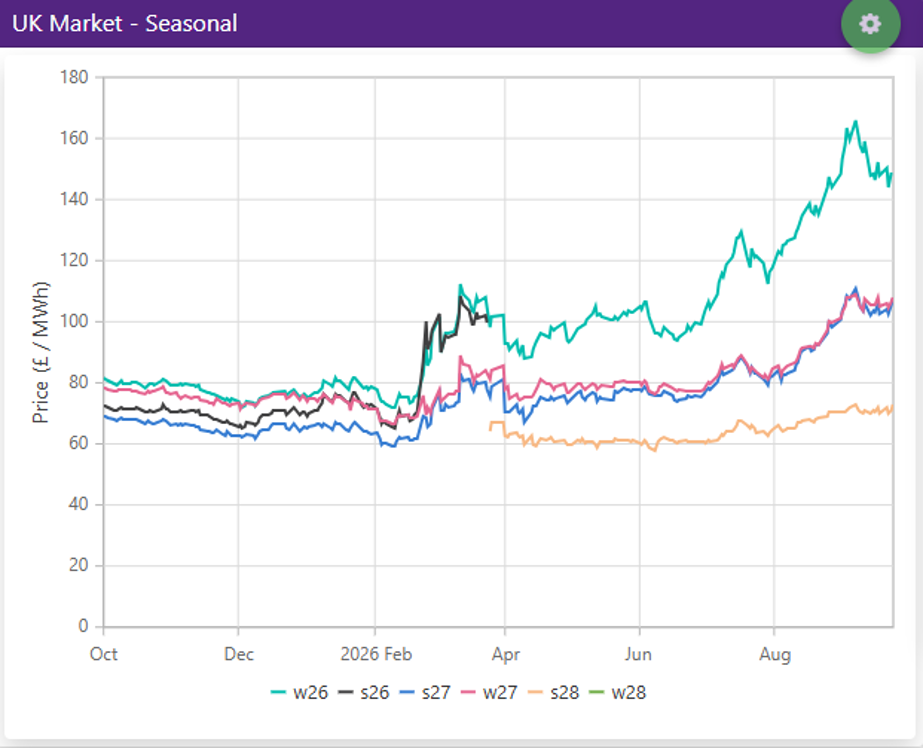
UK wholesale gas and electricity prices continued to rise throughout September, with concerns around winter supply security remaining the key market driver. Lower than average European gas storage levels, Norwegian supply constraints and ongoing competition for LNG cargoes continued to support prices, while periods of weaker renewable generation added pressure to power markets. Despite ongoing volatility linked to geopolitical developments, market sentiment remained bullish overall, with both gas and electricity forward contracts ending the month higher than they began.

Oil Market

Brent crude prices experienced significant volatility through September, initially extending the gains recorded in August before retreating later in the month. Early strength was driven by persistent supply side concerns, with ongoing geopolitical tensions in the Middle East and continued disruption to regional oil flows supporting a substantial risk premium. Tight physical market conditions, declining global inventories and elevated refining margins also provided support as market participants remained focused on the availability of near-term supplies.
As the month progressed, prices came under pressure as traders reassessed the balance between supply risks and weakening demand fundamentals. While concerns over disrupted production and export flows remained prevalent, attention increasingly turned towards softer global demand expectations and uncertainty surrounding the outlook for economic growth. Forecasts for oil consumption were revised lower by several market observers, reflecting continued weakness across key industrial regions and slower than expected economic activity.
Despite periods of weakness, market sentiment continued to receive support from the risk that ongoing geopolitical tensions could further disrupt global supply chains. Traders remained particularly focused on developments in the Middle East, where instability continued to present upside risks to global oil markets.
Overall, September was characterised by heightened volatility and a shift away from the strong upward momentum seen in previous months. While supply disruptions, inventory draws and geopolitical uncertainty continued to underpin the market, growing concerns over demand and the wider economic outlook prevented prices from sustaining their earlier gains.
Carbon Prices

UK carbon prices remained broadly firm through September, with the monthly average increasing to around £60.0 per tonne, compared with approximately £59.5 per tonne in August. Prices strengthened during the first half of the month, supported by improving sentiment across wider energy markets and ongoing expectations that the UK ETS will become increasingly restrictive over time. Market participants also continued to assess the impact of the inclusion of domestic maritime emissions within the scheme, which is expected to increase future compliance demand for allowances.
Momentum weakened during the middle of the month as traders reacted to increased allowance supply following revisions to the 2026 UK ETS auction schedule, prompting some profit taking after earlier gains. However, prices subsequently recovered, with confidence returning as the market focused on the longer-term fundamentals of the scheme and the UK's continued commitment to carbon pricing as a key decarbonisation mechanism.
Overall, September was characterised by moderate volatility, but a modest upward trend compared with August. While increased auction supply, cautious industrial demand and broader economic uncertainty limited more substantial gains, expectations of tighter future carbon constraints and expanding compliance obligations continued to provide underlying support for prices.
Get in Touch
Our team are independent energy advisors who provide competitive gas, electricity, and water prices for commercial businesses across the region.
Our complete energy management service also includes helping businesses to identify potential savings through energy audits, tax levy rebates and grant funding. We can also help you plan for Net Zero and achieve compliance with our in-house ESOS assessment service.
Contact us for a free initial consultation about your business energy.
0114 327 2645


Comments