


Middle East Conflict Drives Energy Prices
UK Energy Market Update
March 2026
Market Summary
EU gas storage continued to edge lower through March, slipping from around 30% to just over 28% by month-end as the Winter-25 withdrawal season ended, finishing below both the five-year norm and the recent three-year average. Early-month heating demand kept withdrawals elevated across Northern and Western Europe, with Germany, France and the Netherlands remaining among the most depleted major markets, although milder weather later in the month helped slow drawdowns to the weakest March pace in seven years. Strong LNG arrivals and rising injections offered some late support, but inventories still ended only marginally above the 2022 seasonal lows, leaving Europe with a thin buffer heading into the summer refill season and reinforcing the need for sustained injections ahead of Winter-26.
Middle East tensions escalated sharply through March as the US-Israeli campaign against Iran intensified, culminating in the effective closure of the Strait of Hormuz and severe disruption to regional oil and LNG flows. Key flashpoints included the rapid collapse in tanker movements early in the month, the 18 March strike on Iran’s South Pars and Asaluyeh gas infrastructure, and further retaliatory attacks on Gulf energy assets, all of which heightened fears of prolonged supply losses across global gas and crude markets. The disruption pushed tanker insurance premiums higher and forced some vessels to reroute, adding short-term delivery uncertainty. Spot market volatility spiked as traders adjusted positions and increased hedging to manage geopolitical risk. Analysts noted that these events were likely to keep energy risk premiums elevated for the remainder of the spring. For UK markets, the impact was felt through stronger prompt gas and power prices, as the risk to Qatari LNG cargoes and wider shipping disruption tightened Europe’s supply outlook, while Brent crude’s move above $100/bbl added further bullish pressure to UK wholesale power through higher oil-linked LNG and fuel costs. By month-end, volatility remained elevated as traders priced ongoing geopolitical risk premiums into both summer and Winter-26 contracts.
EU policymakers reviewed gas storage and market intervention rules to manage the impact of the Middle East conflict and contain price volatility. The European Commission encouraged earlier refilling of gas storage and allowed flexibility around storage targets to prevent panic buying amid tight global supplies. Discussions on temporary price caps resurfaced, with some countries introducing national limits and the G7 pledging coordinated action if conditions worsened. Energy savings and demand reduction measures were also promoted across the EU to prepare for potential prolonged disruption. In the UK, government briefings highlighted that domestic supplies remain secure, though debates continued on whether additional household support or hedge adjustments would be needed if wholesale prices remain elevated.
Global LNG flows remained tight through most of March, supporting European gas prices as Asian demand and Middle East disruptions limited cargo availability. Early- to mid-month draws from Chinese and Japanese storage reduced surplus LNG for Europe, while delays from Qatari shipments added further supply risk. By late March, however, stronger LNG arrivals at European terminals helped stabilise injections, partially offsetting withdrawals and supporting inventories heading into April. The constrained flows for most of the month sustained a premium on short-term gas prices, reinforcing concerns over summer refill economics and Winter-26 supply adequacy.
Net Zero News
Chancellor Rachel Reeves has announced to the UK’s upstream oil and gas sector that the Energy Profits Levy (EPL) will be ended next year, three years ahead of the Labour Party’s original schedule.
A new cross-industry standard for certifying UK buildings as net-zero carbon has been launched, with its developers saying it will “bring much-needed clarity and consistency.”
An expanding group of countries is supporting a significant increase in nuclear power, as governments seek reliable low-carbon energy to meet climate goals and bolster energy security.
New analysis from char.gy shows that electric vehicle drivers can now travel much farther on £20 of electricity than petrol drivers can on the same amount of fuel.
A new report from LCP Delta indicates that targeted reforms to Britain’s electricity network could reduce constraint costs by as much as £3.8 billion by 2030.
The UK Government has opened a consultation on new rules to curb speculative applications for electricity grid connections, following a sharp rise in the transmission network’s demand connection queue.
Nearly 80% of the world’s largest companies and over half of SMEs are now requesting more detailed information from their suppliers on climate-related impacts and risks.
Businesses and households across Britain could benefit financially by shifting how and when they use electricity, thanks to new rules introduced by the National Energy System Operator (NESO).
Nearly 30 businesses serving the UK’s energy, transport, and built environment sectors have pledged to accelerate decarbonisation and work together to reduce supply chain emissions.
Investment in Europe’s energy transition reached a record $583 billion (£431.3 billion) in 2025, up 19% year on year and outpacing growth in both the US and China.
A low-carbon, data-driven insights platform has identified over £10 million in potential cost savings for small businesses across the UK.
Electricity & Gas Prices
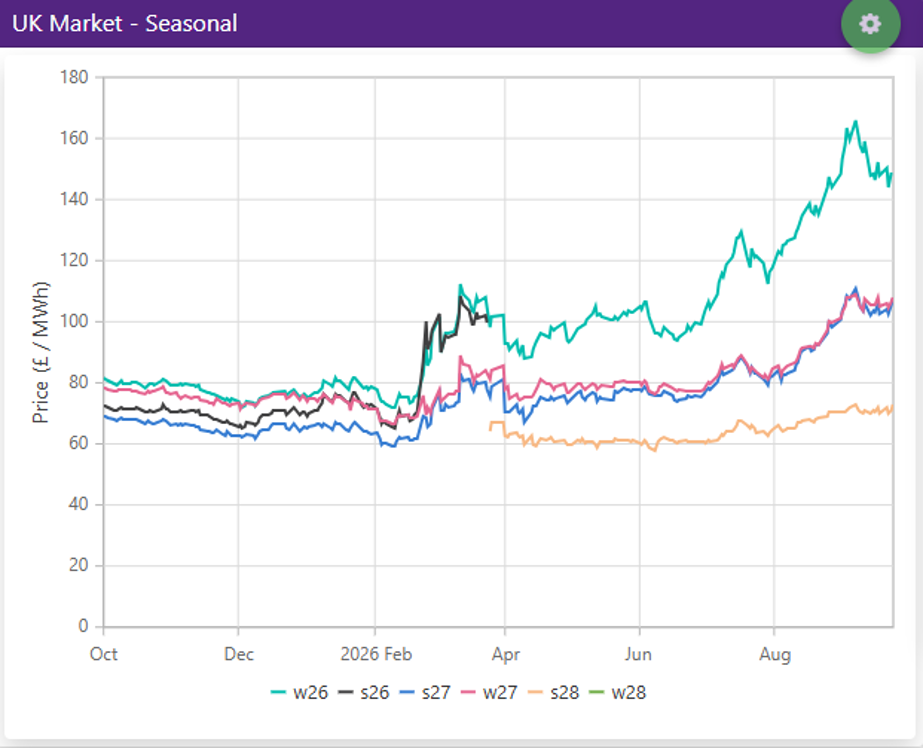
UK wholesale gas and electricity prices rose strongly over March, reversing the softer trends seen earlier in the year. Markets were driven higher by heightened geopolitical tensions in the Middle East, tight European gas supplies, elevated LNG and crude oil prices, and ongoing concerns over low storage levels. Prompt and forward power prices followed suit, supported by higher gas costs and intermittent cold spells that boosted demand for heating and generation. While late-month LNG arrivals and injections helped ease some short-term tightness, market sentiment remained cautious and volatility persisted across both gas and power curves. Overall, March was characterised by a clear upward trend as structural supply pressures and geopolitical uncertainty outweighed moderating seasonal factors.


Oil Market

In March 2026, Brent crude prices rose sharply over the month, reflecting heightened geopolitical tensions and supply uncertainty.
Prices strengthened early in the month as the US-Israeli campaign against Iran intensified, including attacks on key Gulf energy infrastructure and the effective closure of the Strait of Hormuz. Concerns over prolonged disruption to regional oil flows lifted the geopolitical risk premium, while tight supply expectations from OPEC+ and other key producers supported the market.
Mid-month, volatility surged as shipping delays, tanker rerouting, and elevated insurance premiums heightened uncertainty. In response to rising prices and potential supply disruptions, IEA member countries announced the largest coordinated release of strategic oil reserves in the agency’s history, totalling around 400 million barrels, providing some downward pressure and highlighting the scale of global policy intervention.
By the end of March, crude remained elevated, with volatility persisting as markets balanced the risk of ongoing disruption against potential diplomatic or logistical relief. Overall, March was characterised by a clear upward trend, driven by structural supply risks, heightened geopolitical uncertainty, and unprecedented emergency reserve action.
Carbon Prices

In March 2026, EUA carbon prices averaged around €71 per tonne, down from February’s average of €77/tonne. The decline reflected persistent structural and policy uncertainties, with the market remaining sensitive to both EU emissions rules and broader energy price dynamics. Volatility was pronounced as traders weighed the ongoing geopolitical tensions in the Middle East against domestic and EU policy signals.
Early in the month, carbon allowances traded near multi-day highs, supported by stronger industrial demand and higher fossil fuel prices, which increased the cost of emitting and encouraged compliance buying. Mid-month, prices retraced as EU leaders’ discussions on potential ETS reforms signalled a possible softening of rules, prompting profit-taking and technical selling. Analysts also highlighted uncertainty over post-2025 emission targets, which further constrained sustained upward momentum.
Market participants responded with increased hedging and risk-off positioning, contributing to wide intra-month price swings. By month-end, prices stabilised modestly, aided by steady auction volumes and ongoing compliance-driven demand, though the market remained cautious. Overall, March was characterised by a moderate downward shift from February’s average, with geopolitical tensions and regulatory uncertainty keeping price volatility elevated.
Get in Touch
Our team are independent energy advisors who provide competitive gas, electricity, and water prices for commercial businesses across the region.
Our complete energy management service also includes helping businesses to identify potential savings through energy audits, tax levy rebates and grant funding. We can also help you plan for Net Zero and achieve compliance with our in-house ESOS assessment service.
Contact us for a free initial consultation about your business energy.
0114 327 2645



Comments